
Murderland: Crime and Bloodlust in the Time of Serial Killers by Caroline Fraser
Read By Patty Nieman
Published: June 2025
Summary from Goodreads:
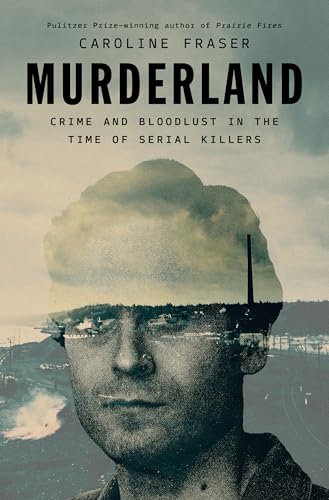
A terrifying true-crime history of serial killers in the Pacific Northwest and beyond – from the Pulitzer Prize-winning author of Prairie Fires
Caroline Fraser grew up in the shadow of Ted Bundy, the most notorious serial murderer of women in American history, surrounded by his hunting grounds and mountain body dumps, in the brooding landscape of the Pacific Northwest. But in the 1970s and 80s, Bundy was just one perpetrator amid an uncanny explosion of serial rape and murder across the region. Why so many? Why so weirdly and nightmarishly gruesome? Why the senseless rise and then sudden fall of an epidemic of serial killing?
As Murderland indelibly maps the lives and careers of Bundy and his infamous peers in mayhem – the Green River Killer, the I-5 Killer, the Night Stalker, the Hillside Strangler, even Charles Manson – Fraser’s Northwestern death trip begins to uncover a deeper mystery and an overlapping pattern of environmental destruction. At ground zero in Ted Bundy’s Tacoma, stood one of the most poisonous lead, copper, and arsenic smelters in the world, but it was only one among many that dotted the area.
As Fraser’s investigation inexorably proceeds, evidence mounts that the plumes of western smelters not only sickened and blighted millions of lives, but also warped young minds, spawning a generation of serial killers.A propulsive non-fiction thriller, Murderland transcends true-crime voyeurism and noir mythology, taking readers on a profound quest into the dark heart of the real American berserk.

Confession:
“Recipes for making a serial killer may vary, including such ingredients as poverty, crude forceps delivery, poor diet, physical and sexual abuse, brain damage and neglect… Many horrors play a role in warping these tortured souls, but what happens if we add a light dusting from the periodic table on top of all that trauma? How about a little lead in your tea?” (pg 204)
This has to be one of the most compelling nonfiction books I have read in a long time. I had a really hard time putting this one down. The author’s argument, that lead, arsenic and other chemicals in our air, dirt and water, helped to contribute to the spate of serial killers in the 70’s and 80’s, especially here in the Pacific Northwest is an interesting one and perhaps merits more investigation. I did struggle a bit with her narrative style and with her obsession with bridges and geological fault lines, but I overall I found the book fascinating.
The narrator, Patty Nieman, did an excellent job with the narration. Nonfiction audiobooks must be hard to narrate and not sound boring. Ms Nieman did an excellent job keeping the pacing and the content interesting. You could even hear sarcasm in her voice when she was talking about some of the manipulations by the corporations and the government that were going on. Ms Nieman is someone I would listen to again, especially a another nonfiction book.
The overall focus of the book are the serial killers, mostly Ted Bundy, but there is a memoir aspect to it as well. The author grew up on Mercer Island, which is connected to Seattle with a floating bridge. She was born in early 1960’s and grew up in the area. Her cultural references and some of the things that she experienced growing up in the area, were interesting insights into the people she is talking about. Perhaps she goes into her life a bit too much, but I found her life to be eerily similar to my own, which made the story more interesting to me. She does hyper focus on all of the accidents that happen on the floating bridge that connects the island to Seattle and the Eastside, but I did get how that would influence a person growing up on the island. Even though the bridge is no longer there, people today still talk about how dangerous it was.
I also struggled a little bit with her jumping around in the timelines. The chapters were really long and the time jumping was a bit of a struggle, especially as I was listening to the story. It was sometimes hard to remember where in history we were. Also the level of detail on the murders the serial killers committed, took a bit away from her main thesis.
I do think that she makes a good case for the highly toxic environments these men grew up in being a factor in making them aggressive and murderers. She never states that this is the root cause, but only a factor of the problem. These facts are bolstered by the statistics that crime is declining as we clean up some of these sites, but the overall science and connections were a bit on the vague side. She also does a really good job of showing how the corporations and the governments covered a lot of this up in their reports, (nothing new there I’m afraid.) Overall I think this is a well researched and compelling narrative that makes sense.
If you are at all interested in the why of serial killers this would be an interesting read for you. You might not find the history of the area as interesting as I did, mostly because I live here, but the overall premise is very interesting. I must warn you that if you are at all squeamish about rape, murder and the horrific things done to some of the victims, then you might want to skip this one. But if you can get past that, this is a very interesting story.
 Confessions of a Serial Reader