A World Without Summer by Nicholas Day
With Art by Yas Imamura
Published: September 2025
Summary from Goodreads:
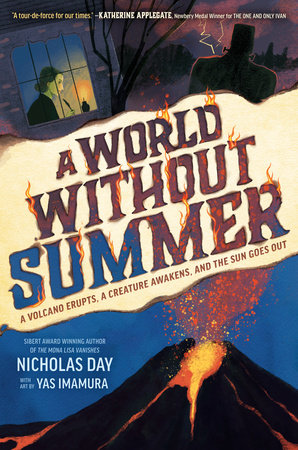
Discover how Mount Tambora’s catastrophic eruption plunged the world into darkness, altering the global climate and inspiring the likes of Mary Shelley’s Frankenstein.
The world was upside-down. The wind was fire. The sky was ash. The rain was rock.
When Mount Tambora, a volcano on the edge of the Indonesian archipelago, erupted in April 1815, it was the largest explosion in recorded history. The land around Indonesia was a hellscape of fire and smoke. In the months and years that followed, the fallout—a cloud of impossibly fine ash— spread through the atmosphere. It killed harvests on the other side of the world. It turned farmers into beggars and their children into orphans. It turned sunsets into molten nightmares.
That same year, eighteen-year-old Mary Shelley fled England with poet Percy Shelley. While sheltering from the worst summer in Switzerland’s history, she watched the explosive thunderstorms over Lake Geneva and caught the spark of an idea. Almost overnight, Frankenstein was written.
In this work of middle grade nonfiction, Nicholas Day traces the forward and backward of a single event, weaving in the many people, places, and things that were affected—and created and invented!—as a result, while tackling the ever-worrying issue of climate change.

Confession:
I didn’t realize when I decided to pick this one up that it was aimed at middle school age children. But I was ok with that, although I did struggle a bit with author’s writing style. This was a very interesting look at how one single cataclysmic event starts a cascading chain of events that affected the entire world.
This is a very well researched book that tried to encompass quite a bit of history, and for the most part did a good job. I did think that his trying to connect Mary Shelley’s Frankenstein to the climate changes that were happening, was a bit of a stretch. It perhaps would have been better to focus a bit more on the science of how volcanic eruptions affect weather and climate, and the people who lived in Indonesia where the volcano was. But the focus on Mary Shelley did add a bit of a human element to the story.
Very little was written at the time of the actual volcano’s explosion, but what the author was able to find sounded rather horrific. How much that one event back in 1815 affected the whole world for about three years is amazing. There were accounts of snow that was red and yellow, falling from the sky. There were extreme droughts in the US and too much rain in Europe. Because of this, diseases also ravaged an already weak population. The author does and excellent job of explaining all of this fallout from the eruption in an interesting and engaging way.
The author’s writing style is engaging and will appeal to young audiences. I struggled a little bit with the short sentences and chapters, and sometimes the narrative appeared somewhat disjointed. But it has been my experience when I was a school librarian that this style appeals to kids, so I’m sure most kids will enjoy this book. I liked the addition of the drawings, they added a nice touch to the book as a whole. I would have liked a map of Indonesia and of the world, perhaps to give a bit of a perspective of how global this story is.
One other thing that was a little bit troubling was how US and Eurocentric the stories were. This perhaps could be because there were no accounts available from other parts of the world. But I think perhaps that could have been stated somehow in the narrative.
Overall I found this to be an engaging and easy nonfiction book. It is one I recommend to both kids and adults. The science behind the eruption effects on the climate of the time is easily accessible by lay people and may spark further questions and research by the reader.
 Confessions of a Serial Reader